
By Audrey Herrin
The first time I became acquainted with Edinburgh, I was sixteen years old. I had been bitten by the travel bug, and I was abroad in Europe for the first time, without my family.
I climbed the ramp out of Waverley station, emerged blinking into the sunlight, and suddenly a real-life Gothic city yawned before my stunned eyes. It was like a setting from a movie screen, except it surrounded me on all sides and swallowed me up in its splendor.
To my right, the hustle and bustle of Princes street, and Georgian facades of New Town. To my left, the jagged spires on the hillside of Old Town. Weather-stained sandstone walls spilled into each other, crowded over hidden alleys and staircases, one after the other, up and up, all the way to the castle on the volcanic ridge, which loomed over everything.
It was an utterly alien landscape compared to my home in Seattle. In the US, especially the West Coast, we have no shortage of wide open space. Everything is well-lit, and divided into grid-shaped blocks, front yards, and leisurely boulevards.
In contrast, Edinburgh’s Old Town is like David Bowie’s labyrinth. Mysterious stenches emit from its dark ‘closes.’ It’s easy to get lost, with streets criss-crossed on top of each other. Everything is a jumble of twists and turns, dead ends, and abandoned alleys where drunks loiter in the shadows. The perfect place to lose yourself completely in the night. In the morning, re-emerge, seemingly unchanged.
The pull towards Edinburgh was irresistable, and I moved to Scotland at age eighteen to study English Literature. In my first year, we read The Strange Case of Dr. Jekyll and Mr Hyde (1886), by Robert Louis Stevenson. While the novella is set in London, there is compelling evidence that Edinburgh is the true inspiration behind it. Especially given that Stevenson grew up there, and had a lifelong fascination with the city.
The novella depicts a stark contrast between a wealthy, respectable area, and a seedy, underbelly part of town – which evokes the contrast between Edinburgh’s Old and New Town. In Stevenson’s time, there was a sharp class divide between the two. While the latter was designed to attract elites and respected professionals to Scotland’s capitol, the former became increasingly overcrowded and poverty-stricken. For a long period of history, Old Towners and New Towners lived in separate worlds and rarely interacted.
During my time in Edinburgh, I discovered an entertaining way to understand the historic divide between Old Town and New Town. I visited The Real Mary King’s Close in Old Town, an interactive tour through the foundations of a buried street, to learn about the cramped squalor that people used to live in. Then, in New Town, I toured The Georgian House – a restored 18th century townhouse. Next door, is the current residence of the First Minister of Scotland – just off George Street, which is lined with bougie coffee shops, clothing stores, and restaurants. You can really get a sense of how the two parts of town, divided by Princes Street, represented two different walks of life.
The themes of Dr. Jekyll and Mr. Hyde resonate with the gothic atmosphere of Edinburgh, and the dual-identitied protagonist is likely based on the real-life figure of Edinburgh nobleman and secret criminal Deacon Brodie.
Brodie was a respected cabinet-maker and locksmith, as well as a member of the town council. But he led a double life. He copied his wealthy client’s keys so he could rob them in the night, to fund his dirty habits of gambling, drinking, and affairs. Brodie was the inspiration for not only Stevenson, but other writers throughout the ages, including Muriel Spark. The titular character of Spark’s The Prime of Miss Jean Brodie (1961) even claims to be inherited from Deacon Brodie himself.
I have seen the cabinet designed by Deacon Brodie, which was owned by Robert Louis Stevenson. The cabinet is on display at The Writer’s Museum (my favorite Edinburgh tourist attraction, which displays artifacts connected to famous writers from the city). Each time I walked through the Royal Mile, I passed Deacon Brodie’s Tavern. Across the street is St. Giles Cathedral, which is black and massive like a fortress of doom. Brodie was hung on the gallows in front of this cathedral before an eager crowd in 1788.
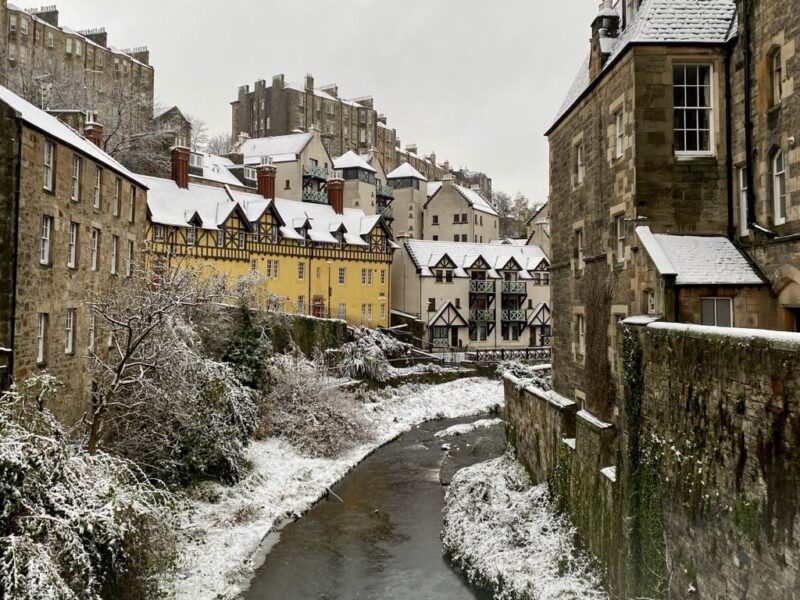
I embraced Edinburgh as the gothic city of Deacon Brodie and Dr. Jekyll and Mr. Hyde. Up until this point, I had always been a ‘good girl.’ I always came home on time in high school, and my parents never had to worry about me. But something repressed within me was growling and clawing its way out.
Like Mr. Hyde on his secret midnight outings, I delved deep into the alleys of Old Town, which I explored while simultaneously cartographing a new facet of my own identity. I kept company with a Dr. Jekyll/Hyde – esque lover. Many nights found us in Cowgate, the basement of Old Town, which reeks of vomit and alcohol. He had a dank and drafty flat, behind a black door at the top of a spiral staircase, somewhere among rows and rows of identical flats in the Old Town labyrinth.
I was lucky. Coming face to face with his ‘Hyde’ personality was enough to shock me to my senses, and I escaped relatively unscarred. Later, I tried to find his door in the sober daylight, but I could never find it. It was as if it vanished from Edinburgh, along with him.
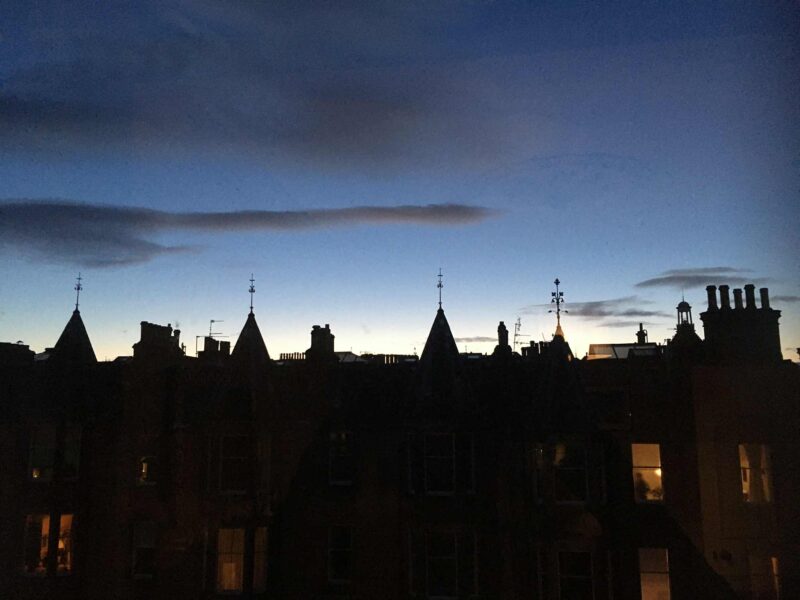
Stevenson’s Dr. Jekyll and Mr. Hyde was inspired by an earlier novel which was set in Edinburgh; The Private Memoirs and Confessions of a Justified Sinner (1824) by Thomas Hogg. Like Dr. Jekyll, the main character of this novel grapples with a malicious doppelganger who influences him to commit acts of evil.
The themes of doppelgangers and dual-identity surface repeatedly in Edinburgh literature. In The Prime of Miss Jean Brodie by Muriel Spark, and in the Inspector Rebus series by Ian Rankin (1980-90’s). The main characters of these stories both hold influential positions in society (school teacher, police officer), but both have a dark side that bely their facade of respectability. Jean Brodie is manipulative, narcissistic, and a Fascist. Inspector Rebus is (at worst) a cynical alcoholic.
One day, I visited St. Leonards police precinct – where Inspector John Rebus operates from in most of the books by Ian Rankin. A friendly officer took my fingerprints there for my visa application. The stone building is on the outskirts of Old Town, and the volcanic ridges of Holyrood Park loom behind it.
The tallest of these crags is Arthur’s Seat, the setting of a chilling scene from Hogg’s Confessions of a Justified Sinner, in which a character sees a demonic apparition of his brother. This foreshadows how his brother will later murder him under the influence of his evil doppelganger.
The relationship between this novel’s main character and his doppelganger inspired Inspector Rebus’s relationship with his nemesis, ‘Ger’ Cafferty, who acts as an inverted mirror to illuminate the darker potentialities of Rebus’s personality.
I too, have summited Arthur’s Seat in the late or early hours of sunrise and sunset to watch the sun paint the hills and church spires in amber. I have seen my shadow grow long on the mist, like an apparition with a mind of its own.
These literary landmarks are all around Edinburgh. A city in which characters often have to come face to face with their Jungian ‘shadow selves.’
With its towering crags and spires that reach towards the sun, contrasted by its sudden plunging staircases and shadowed closes, Edinburgh is a city of both light and dark. It invites contemplation of the duality inherent in our nature.
After graduation, I moved to Edinburgh’s New Town, and grappled with the prospect of making something respectable of myself. New Town is still the wealthiest part of Edinburgh. Expensive bars and restaurants fill New Town, where I began to work as a server, and saw beneath the masquerade of wealth and respectability.
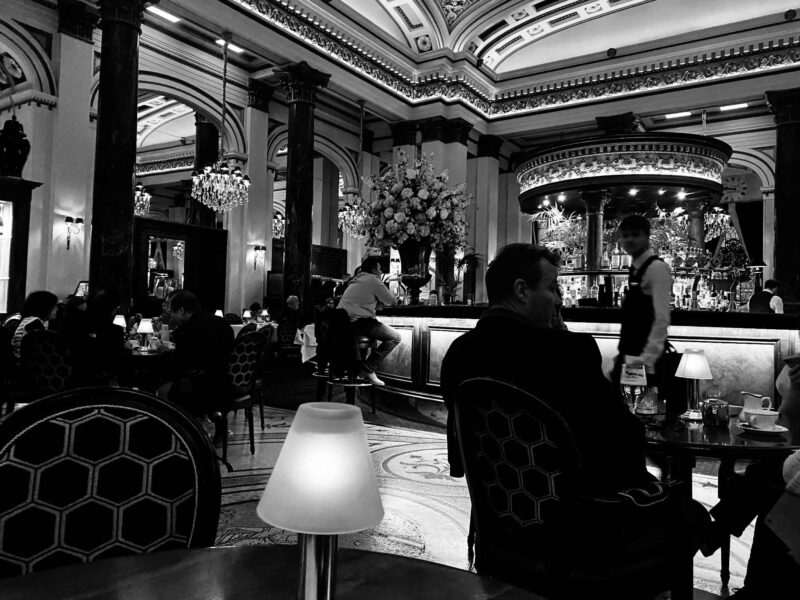
The bar was inside a grand, Georgian-era lobby. Every inch of the columns and mosaic floor had to be scrubbed clean on a daily basis. Not a speck of dust could be allowed to defile the dining experience of our illustrious customers. But behind the scenes, the most sordid behavior was allowed free reign among the staff. Scandals were swept under the rug by upper-management, and rats darted beneath the tables after the customers were gone. No matter how hard they made me scrub each surface with chemicals that burned my eyes – there were dark, mysterious stains that never went away.

Audrey Herrin is an aspiring journalist from Seattle, Washington, with a degree in English Literature from the University of St. Andrews in Scotland. Her work has previously been published in Intrepid Times magazine, among others. She is an avid reader, writer, and traveler; and she writes about her adventures and miscellaneous musings on Substack: @Bookish Backpacker.
All photos by Audrey Herrin